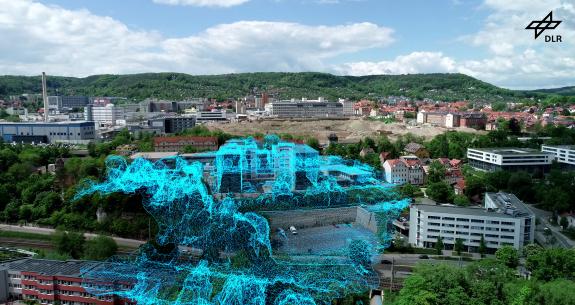
[AI Explainability]: Demystifying AI—Understanding How Artificial Intelligence Thinks and Makes Decisions
Artificial intelligence delivers results—but how are these decisions made? Using typical DLR examples, you’ll learn step by step how AI is trained, how it makes decisions, how it quantifies uncertainties, and why transparency is essential—especially in safety-critical systems. This station explains the basics of AI explainability in an understandable and clear way.
The German Aerospace Center (DLR) is the Federal Republic of Germany’s research center for aerospace, energy, transportation, and safety.
At its Jena location, theDLR Institute of Data Sciences researches and develops methods to generate knowledge from data, drive innovation, and support informed decision-making. In doing so, the institute takes a holistic approach across the entire data lifecycle—from data collection and processing to machine learning and the derivation of concrete recommendations for action.
To process large volumes of data and further develop modern AI methods, the institute operates a high-performance HPDA supercomputer cluster, which is also available to collaboration partners and small and medium-sized enterprises (SMEs).
In this way, the institute supports the innovative and efficient use of data in science, business, and society. At the same time, it promotes sustainable processes as well as robust and future-proof technologies for the DLR’s diverse areas of application.
At the DLR_School_Lab Jena, students can independently explore current DLR research topics through fascinating experiments. To this end, the student lab offers free STEM project days for school classes starting in the 2nd grade to foster scientific curiosity from an early age. This evening, too, a colorful program for the whole family awaits you there (Leutragraben 4)—come check it out!