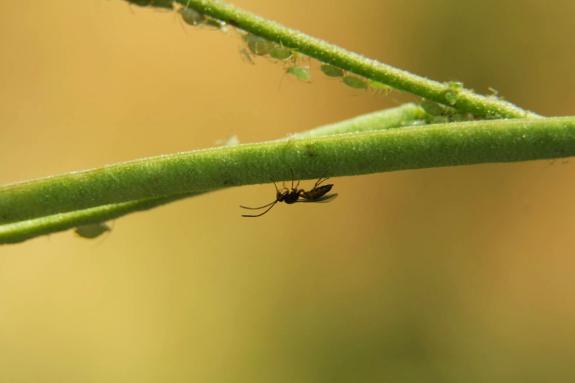
Since we study the natural interactions between plants and insects, we do not use insecticides in the greenhouse. By strategically introducing beneficial insects, we can reduce pest populations and thus protect the environment and save money.
The excessive use of pesticides in agriculture and commercial greenhouses is leading to the emergence of more and more resistant insect strains. As early as 20 years ago, more than 500 insect species were known to be resistant to at least one insecticide, and 17 species were resistant to all major classes of insecticides. Many fungi and other plant pathogens also exhibit resistance to chemical pesticides. By establishing biological or integrated pest management, the greenhouse team at the Max Planck Institute for Chemical Ecology has succeeded in implementing an active and preventive pest control system instead of a reactive system of chemical treatment. By using antagonists—the pests’ natural enemies that feed on or parasitize them—pest infestations can be preventively reduced to a tolerable level.
The goal of integrated pest management and biological pest control is not necessarily to keep the greenhouse facility completely pest-free, but rather to keep pests in check. Appropriate measures can minimize the use of chemical agents, which is absolutely necessary for conducting research experiments, as the study of plant-insect interactions is the focus of our research.
We will introduce some of the pests found in our greenhouse facility and the natural enemies that have been successfully used to control them.
In addition, visitors of all ages can take a quiz to learn more about important crops, many of which are essential to our diet.