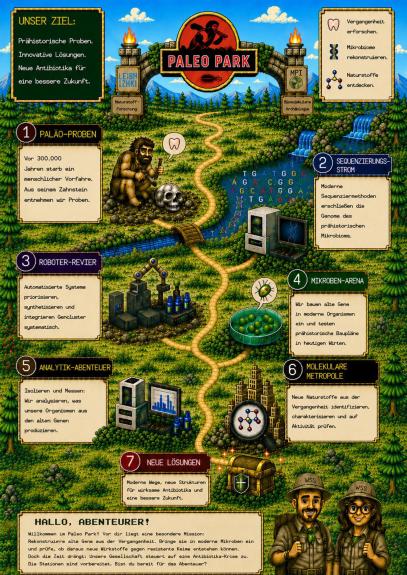
Welcome to Paleo Park!
What can microbes that lived thousands of years ago tell us? And could they perhaps even help us discover new antibiotics? In archaeological samples such as ancient dental calculus, bacterial DNA can remain preserved for very long periods of time. We use this remaining genetic information to identify the blueprints for new natural compounds and to isolate them. Some of these compounds can inhibit or kill other microorganisms and could therefore be of interest for the development of new antibiotics.
During the Long Night of Science, we’ll open our lab and take you on a journey into the microbial past. You’ll become a Paleo Park explorer yourself: Make DNA visible, take a peek into the invisible world of microorganisms, and discover how we piece together and decipher the fragmented information from ancient DNA. Then follow the trail from DNA to the molecule and learn how genetic blueprints give rise to real natural compounds, how we track them down and analyze them in the lab through extraction and chromatography—and how we determine whether a new active ingredient might be hidden among them.
Step into Paleo Park and join us in discovering what’s hidden in ancient DNA!