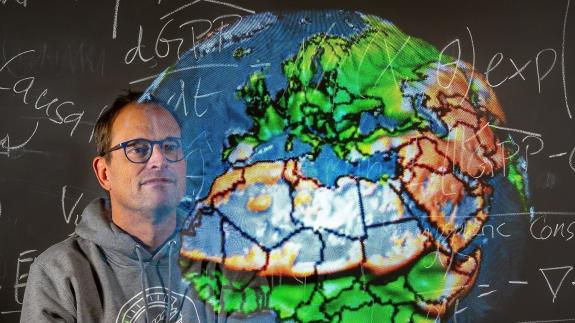
The ELLIS Unit Jena conducts research on artificial intelligence for complex, dynamically changing systems. These include, among others, the climate and Earth systems, ecosystems, the human body and brain, as well as technical and social networks such as energy and mobility systems.
In all these areas, similar fundamental questions take center stage: How can we extract reliable information from sparse, noisy, and heterogeneous data? How can we understand not only correlations but also causes? And how can we develop models that align with our knowledge of physical, biological, or social processes while remaining interpretable?
To this end, the work of the ELLIS Unit Jena brings together various disciplines—ranging from environmental research to medicine and neuroscience to technical applications. Despite their diversity, these systems exhibit common structural and dynamic principles that can be investigated using shared methodological approaches.
What is ELLIS?
ELLIS stands for “Learning and Intelligent Systems European Laboratory for Learning and Intelligent Systems” and is a pan-European network of excellence in AI research. It is based on machine learning as the central driver of modern artificial intelligence and aims to secure the long-term international leadership of AI “Made in Europe.” To this end, ELLIS connects leading researchers and creates a multicenter, Europe-wide AI cluster, of which the ELLIS Unit Jena is a part.
Today, ELLIS comprises over 2,000 members at 49 locations. The research is organized into 16 scientific thematic programs that cover key questions in artificial intelligence, ranging from fundamentals to applications. This is complemented by a robust PhD program with more than 500 doctoral students who are trained within this network.
ELLIS members are committed to actively shaping the future of AI in Europe by pushing scientific and technological boundaries—toward AI systems that are powerful, human-centered, useful, and safe. Close collaboration across countries and disciplines creates a unique research ecosystem that brings together cutting-edge research while simultaneously making an impact on society.