Fish in ageing research – ageing in fast-forward?
We’d like to introduce you to the Turquoise Splendid Cichlid (Nothobranchius furzeri). This fish lives in seasonally drying pools in south-east Africa, where rainfall is rare and unpredictable. The fish has adapted perfectly to this unique habitat. For example, the fertilised eggs are enclosed in a tough shell to protect them from drying out and to enable them to survive prolonged dry spells.
As soon as the dried-up pools are filled with water again, the fish hatch; they reach sexual maturity within a few weeks and mate. The fish ages very quickly, as its natural lifespan is only a few months – almost as if in fast-forward, with the typical signs of ageing seen in humans.
This short lifespan makes the fish a promising model organism in ageing research and helps us to study and understand ageing.
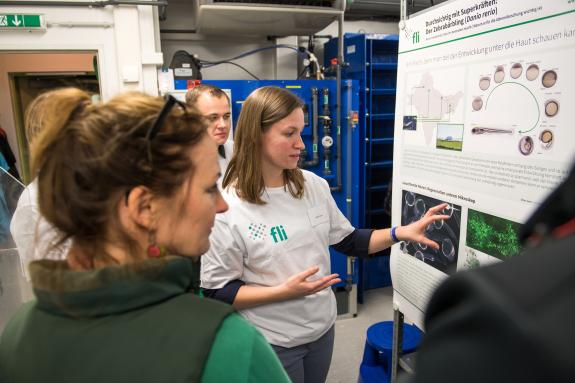
In addition, we conduct research on zebrafish (Danio rerio), which originate from Asia. In this species, embryonic development within the egg takes place entirely outside the mother fish. As the fish remains transparent until it is fully developed, it provides insights into organ development. Under the microscope, it is particularly easy to track the formation of the heart, kidneys and blood vessels. As 70 per cent of the zebrafish’s genes are also found in a similar form in humans, it is a valuable model organism for science, including research into the aetiology of diseases.