The Integrated Carbon Observation System (ICOS) is a Europe-wide observation network that provides highly accurate greenhouse gas measurement data. These data form the basis for the scientific interpretation of trends in greenhouse gas emissions over time. This is a crucial foundation for decisions aimed at mitigating global warming.
ICOS makes standardized data from 180 observation stations in 16 European countries freely available. The stations measure greenhouse gas concentrations in the atmosphere as well as carbon fluxes between the atmosphere and terrestrial ecosystems or the oceans. The measurement data obtained are essential for scientific analyses aimed at estimating the climate-dependent nature of greenhouse gas emissions and making more reliable projections.
ICOS coordinates the respective monitoring networks and is supported by various central institutions. The Max Planck Institute for Biogeochemistry in Jena operates the central laboratory for air sample analysis and the calibration of reference gases. Another central laboratory for determining radiocarbon in carbon dioxide is located at the University of Heidelberg.
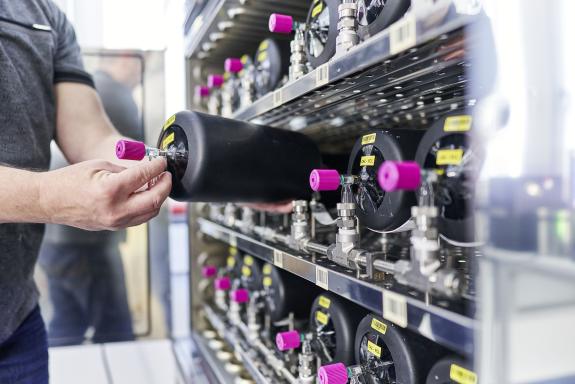
Our flask and calibration laboratory analyzes air samples for their greenhouse gas concentrations and other components that can provide additional clues about specific emission sources. How representative a single air sample is for a given location depends on the meteorological conditions under which it was collected. The flask laboratory has developed automated sampling devices and manufactured them for the ICOS monitoring network. These devices allow for various options for the targeted filling of flasks under specified conditions. This ensures that a single air sample is representative of the respective location and was not collected under unfavorable meteorological conditions.
We invite you to visit our laboratory and learn why it is complicated to determine trace gases in the air with high precision. We’ll show you how we ensure a high level of measurement accuracy. See where these measurements are taken—from Spitsbergen to Lampedusa.
No future events in this series.