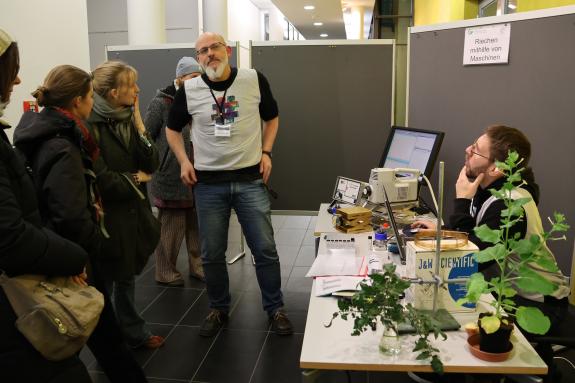
Smelling with the Help of Machines
At our institute, we study how different organisms—particularly plants and insects—communicate with one another using chemical signals. These signals often involve scents that insects perceive through their sense of smell and then interpret. Odors are detected by specialized olfactory receptors that respond to specific chemical compounds.
Humans lack the receptors for most of these scents, so we cannot smell them at all. Furthermore, our sense of smell is nowhere near as sensitive as that of moths, for example. And when it comes to complex mixtures of substances, we would not even be able to identify the individual compounds as such.
To observe this form of communication nonetheless—and to measure which volatile substances plants and animals emit and in what quantities—we use highly sensitive devices developed specifically for this purpose. We will demonstrate one of these devices to visitors and explain how it works.