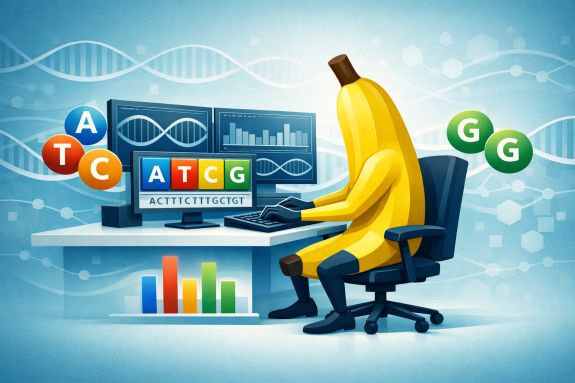
Just how similar are we really to a banana, a mouse, or a monkey, and why do we keep hearing statements like that? This talk takes a closer look at well-known “genetic fun facts” and explains in an accessible way what’s behind them. It quickly becomes clear that behind every seemingly simple percentage lies an exciting mix of biology, data, and clever methods.
We’ll start with a brief journey through the history of genomics: from the first decoding of the human genome to today’s technologies, which make DNA much faster and more affordable to sequence. No technical details—just a sense of how rapidly this field has evolved and why that matters when comparing organisms.
Building on this foundation, we’ll explore how researchers actually determine which genes two species share, what “similarity” means in biology, and why percentages often confuse more than they explain. Instead of complicated technical terms, we’ll use clear examples: What information is contained in DNA sequences? What do they reveal about kinship? And why isn’t it so easy to reduce biological diversity to a single number?
The lecture demonstrates that meaningful comparisons between organisms are possible—but only if you ask the right questions. It explains why some popular claims about genetic closeness are misleading, and how modern bioinformatics helps paint a more realistic picture: one that shows which genes and functions have actually been preserved over millions of years and what that tells us about ourselves and other living beings.
The event is aimed at anyone curious about how science works behind the headlines. It offers an accessible insight into the world of genes and data—and, along the way, clarifies what the deal with the banana really is.