It is not only the Thuringian Forest that is regularly plagued by bark beetle infestations, which are causing many spruce trees to die and will likely alter the entire forest ecosystem in the future. This is primarily due to drought—a consequence of global warming—and the lack of diversity in most of our native forests. However, we also repeatedly find that there are still quite a few unanswered scientific questions regarding the fundamentals—or core issues—of bark beetle infestations themselves, such as exactly which trees are infested and why.
In the Biochemistry Department at the Max Planck Institute for Chemical Ecology, we are trying to find answers to precisely these questions. For example, we are investigating the exact mechanisms from the tree’s perspective. We are interested in why, despite mass reproduction of the bark beetle (the European spruce bark beetle, Ips typographus), some spruce trees (Picea abies) in the forest are preferentially infested while others are not infested at all. To do this, we create genetically modified trees and alter the composition of the tree resin—which is the spruce’s primary defense mechanism—as well as the scent that plays a crucial role in helping the bark beetle locate attractive trees. We then test in the laboratory how the beetles react to these changes.
At the same time, however, we are also trying to gain new insights into the bark beetle. This is because the beetle does not live alone but in symbiosis with a multitude of microorganisms. For example, its body surface harbors a variety of fungi that likely play an important role in the digestion of food. In addition, the beetle’s gut contains a complex mix of specialized bacteria that primarily break down the tree’s toxic defense compounds, thereby making the food more digestible for the beetle. To confirm these hypotheses and ultimately gain a better understanding of this complex system, we are attempting to identify the chemical substances involved and are also conducting tests in our laboratories on the behavior of European spruce bark beetles in the presence of both fungi and bacteria. To gain further insights into this beetle-fungus-bacteria symbiotic system, we are also using the slightly larger and easier-to-rear spruce weevil (Hylobius abietis). Although this beetle feeds only on the bark of young trees, it is likely to harbor a comparable community of fungi and bacteria, since it is exposed to the same constituents and defense compounds in the tree as the European spruce bark beetle.
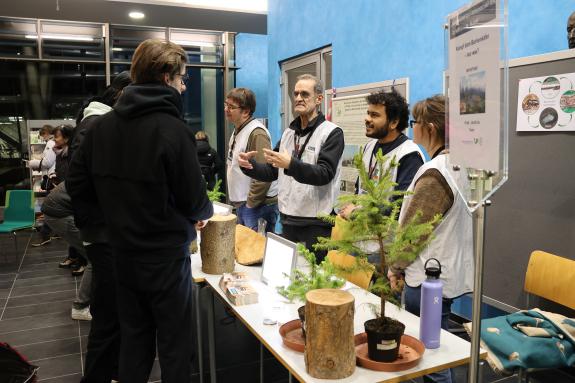
At our booth, we will present not only the latest research findings but also the organisms under study—such as transgenic spruce trees, European spruce bark beetles, and spruce weevils, along with their associated fungi and bacteria—as well as some of the experimental setups used for laboratory testing.