It’s a summer Sunday, and you’re heading to the park with friends for a nice picnic. Everyone is sitting together, talking, laughing, playing, and enjoying the sun and the warmth. When you all start to get hungry, containers of food to share appear, and some of you run off to buy some fries or a currywurst. But then they show up. Suddenly, wasps, flies, and ants swarm all over us. How did they find us? How do moths find our flour packages to invade them and fill them with their maggot-like offspring? How do cockroaches and flies find the food we throw away? How do mosquitoes find tasty humans?
It turns out that insects can smell, and some of them are quite good at it—much better than we humans are. In fact, insects rely on their sense of smell to survive. They use it to find the food they need, to find a suitable mate, to choose a place to lay their eggs, to navigate their way around their nest, and to avoid predators or other dangers.
How do they do that? Odors or scents are chemical substances released by something that can spread through the air or water. Although insects don’t have a nose, they do have thousands of tiny hairs all over their bodies—and especially on their antennae—that function like our noses. These tiny hairs contain specialized nerve cells that are activated when they come into contact with chemical substances. These cells send signals to the insect’s brain to help it decide how to respond to the scent. The ability to perceive odors is very useful. With the help of their sense of smell, insects can detect from a distance that there is something interesting in the direction the wind is blowing.
In the Department of Evolutionary Neuroethology at the Max Planck Institute for Chemical Ecology, we investigate how insects interact with their environment through their sense of smell. We are interested in understanding how interaction with the environment has shaped the sense of smell over millions of years of evolution. That is why we study many insect species. We focus on butterflies, ants, and flies. We investigate which chemicals are present in their environment, how the insects’ sensory cells respond to odors, and how these odors control feeding, mating, and egg-laying behavior. We also study the structure of the insect brain and how insects learn and form memories.
We are also interested in understanding how human-caused environmental pollution affects insects’ ability to smell their environment, in order to support efforts to combat further environmental damage. If we understand how insects smell, we can also develop solutions to control insect pests.
With insects, we can conduct experiments and manipulations that would be too difficult or even impossible in humans or other mammals. And since insects’ sensory systems, while complex, are simpler than our own, we can learn an incredible amount about how they function by studying them.
If we understand how insects function, we can also understand how we function. We, too, can use smells to find food and avoid danger. We can smell when something is baking in the kitchen and even tell what kind of cake is in the oven. We can also smell a gas leak and call for help.
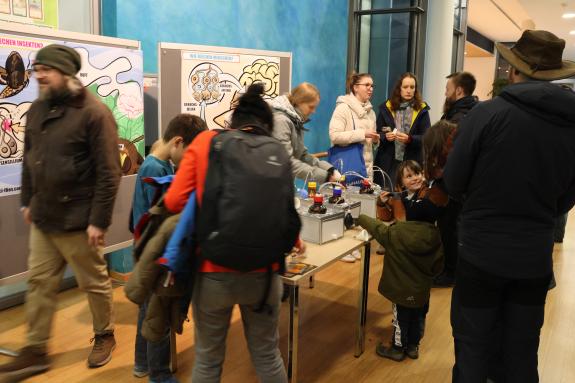
Visit us at our institute and experience firsthand what it’s like to be an insect in a world full of smells. You’ll learn about research involving insects, see our specimens, and observe the experiments we conduct with them. And you can test your own sense of smell in fun contests!