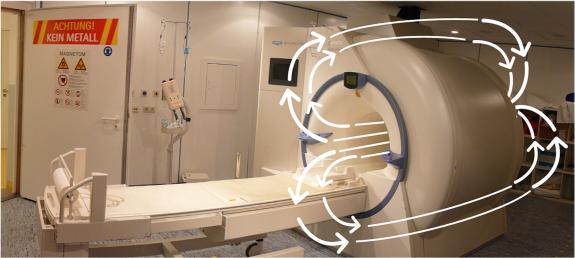
Magnetic resonance imaging (MRI) can be used to produce detailed cross-sectional images of the human body, enabling a precise assessment of organs and pathological changes. MRI is based on a very strong static magnetic field (typically 1.5 to 3 tesla), spatially varying magnetic field gradients, which are used for image localization, and high-frequency alternating electromagnetic fields in the radiofrequency range, which excite the hydrogen nuclei in the body into resonance.
MRI is a safe imaging technique that operates without ionizing radiation. Nevertheless, there have been accidents in the past caused by the strong static magnetic field. These incidents occurred when ferromagnetic materials, such as metallic objects or certain implants, entered the magnetic field and were moved uncontrollably by the strong attractive force.
An important aspect of MRI safety is that the magnet cannot simply be turned off, as it is based on superconducting technology and is continuously cooled. A so-called “quench,” in which the magnetic field is abruptly shut off, is possible but carries risks and is intended only for emergencies.
Learn more about the basics of MRI safety and why certain precautions are essential through our program. Through simple experiments, you can feel the enormous force of the static magnetic field for yourself and experience firsthand why strict safety precautions are so important in MRI.
Medical Note:
Please note that a strong, permanent magnetic field is present that cannot be turned off. For safety reasons, individuals with implants or metallic foreign objects are strongly advised not to enter the magnet room.