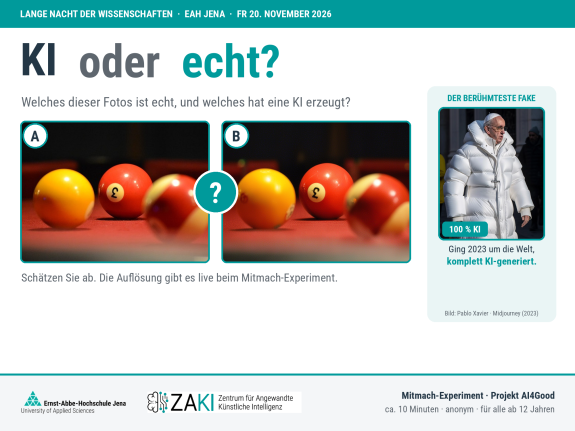
AI or real? The live experiment: Can you spot AI-generated images—and who do you trust when in doubt?
AI-generated images are now so photorealistic that “seeing is believing” no longer applies: In our studies at the Center for Applied Artificial Intelligence (ZAKI), participants performed at random chance levels when distinguishing real photos from AI-generated twins. Even professionals in image forensics fall far short of the performance of automated detectors.
At the Long Night of Science in Jena, you can test yourself and take part in a real live experiment. Here’s how it works: You’ll see a short series of images consisting of real photos and AI-generated “twin images.” First, you’ll estimate how many of the images were generated by AI. Then you’ll receive a second assessment—sometimes from an AI detector, sometimes from a human—and you’ll have the chance to adjust your estimate. This is where it gets exciting: Will you follow the advice? And does it make a difference whether it comes from a machine or a human?
On a live dashboard, you’ll see in real time how the evening’s audience is doing: How well can Jena recognize AI images? To what extent do visitors rely on AI advice compared to human advice? Participation takes about 10 minutes, is anonymous, and can be done at any time. Whoever makes the most accurate guesses that evening will be in the lead in our little contest. We’ll reveal more at the booth. Afterward, we’ll explain the results: Which images were generated by AI, and what details might have given them away?
This event is part of the AI4Good project at ZAKI, Ernst Abbe University of Applied Sciences Jena, funded by the Carl Zeiss Foundation. We’re researching how people respond to advice from AI systems—a key question for dealing with deepfakes, disinformation, and AI-powered warning systems.
We celebrate science!