Anatomy Collection - Discover the wonders of the human body!
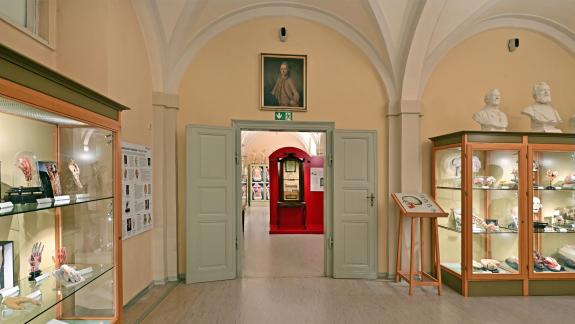
The Jena Anatomy Teaching and Research Collection, which has existed for over 200 years, is housed in two rooms that are part of the university’s oldest building, the Collegium Jenense, a former Dominican monastery. The collection’s permanent exhibition is curated by the Institute of Anatomy. It has been open to the general public since June 2022.
In the front room, known as the Rolfinck Hall, human anatomy is explained by organ system. In newly designed display cases, selected exhibits are shown to their fullest effect, aided by LED lighting installed in 2021. Modern plastinated specimens created at the Institute of Anatomy in recent years are also on display here. They are complemented by historical dried specimens and anatomical models. This hall caters to interest in the anatomy of the human body and is particularly well-suited for educational purposes. A special section provides information on various preparation techniques. The question of the origin of the cadavers used for anatomical studies at different times is also explored in detail.
In the second exhibition room, named after Goethe, visitors can experience the historical significance of the Anatomical Collection. Here, the oldest specimens from the founding period are on display, as well as exhibits that recall Johann Wolfgang von Goethe’s comparative anatomical studies—such as the intermaxillary bone. The exhibition also explores the later history of the collection and the “racial skull” collection established around 1857. A second major focus of the exhibition in this hall is the historical model collection. On display is a wide variety of anatomical models, including an artistic series of wax models on embryology.
Note: The exhibition features body parts from deceased individuals; we ask that you behave respectfully.
Restriction: Children under 12 must be accompanied by an adult. Waiting times may occur during peak hours.
Anatomical Collection Website