From the dried plant to cutting-edge biological research
We invite you to take a look at our exciting research work:
• Take this rare opportunity to join a guided tour of the Herbarium Haussknecht:
7.30 pm and 8.30 pm – Guided tour of the Haussknecht Herbarium (registration on the day)
• Listen to fascinating talks about our research into plant diversity and the history of our institute:
6.00 pm – Talk: Plant wonders. Curiosities from the Guinness Book of Records
6.45 pm – Talk: Senckenberg in Jena?! What plant collections reveal about changes in biodiversity
• Get involved yourself:
• No one can read that! – How artificial intelligence can help with the transcription of handwritten labels.
Modern AI meets historical collections – Find out what data we can already extract today from digitised plant specimens using artificial intelligence and modern image processing.
• Be a plant detective and put your instincts to the test in our exciting quiz and plant memory game. Discover your passion for collecting and learn how to start your own herbarium.
• Nothing happens without moss?! – Look through the microscope, discover the fascinating world of mosses and learn about their enormous importance for our ecosystems.
• The world of stomata – their functions and significance for current research
• Become a ‘Herbonaut’ yourself and join us on the HerbaTour – as a citizen scientist, you can actively support our research with your knowledge and skills.
Since 2024, the Haussknecht Herbarium has formed the research basis for the newly founded Senckenberg Institute for Plant Diversity Jena (SIP), whose scientists are using the collection to study biodiversity and how it is changing. The herbarium houses millions of dried plants and fungi. How can this enormous number of plant specimens be catalogued, processed and made accessible to science?
Alongside traditional research approaches, which often focus on individual plant specimens, modern AI methods help to extract information from digitised data on a large scale. Scientists use this information for biodiversity and climate research, deriving scenarios and recommendations for action for our future. In this way, the SIP combines traditional methods of collection-based research with state-of-the-art, data-driven biodiversity research.
Furthermore, two citizen science projects were launched in May 2026: ‘HerbaTour’ invites interested members of the public to discover the fascinating world of the Haussknecht Herbarium, explore plants and share their own stories about them. As a “Herbonaut”, you can help to decipher historical handwritten plant labels.
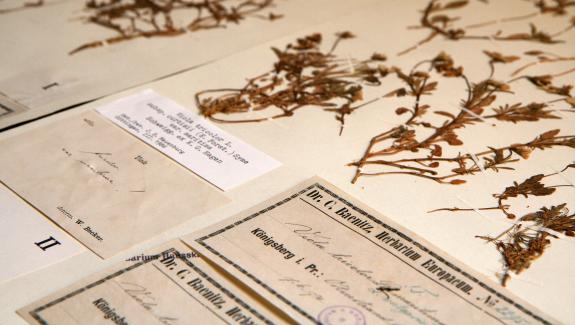
A digital copy of a violet
Kristin Victor