The dynamic, ever-changing, vibrant planet: Earth sciences, the Earth’s potential and risks
• Tectonic collection, hand specimens and thin sections: Alongside the display of the collection, small experiments using everyday materials demonstrate how rock is deformed.
• No two grains of sand are alike: wind, water, ice and gravity determine grain shape and composition. How do processes on the Earth’s surface distribute granular sediment? You’re also welcome to bring along your own holiday sand and examine it under the microscope.
• Crude oil and coal: We consume 100 million barrels of the former and 24 million tonnes of the latter – every day. We display these substances and describe differences in their occurrence and use. How can we move away from relying on them?
• Nanoparticles: We’ll use modern measuring equipment to analyse everyday substances for nanoparticles – for example, in tea, coffee or beer: a demonstration, a puzzle to solve and an examination of small objects you’ve brought along.
• Microfluorescence: Where are which elements found in an ore, a meteorite, rock salt, a computer circuit board or a wristwatch? Join us to experience the capabilities of microfluorescence.
• A journey through the Earth’s history: We’re exhibiting and presenting: What is Tambia spiralis and why does it occur alongside the primeval eggs in the Thuringian Forest?
• We’ll ‘play chess’ with rock samples of sandstone and limestone to understand the movement of fluids underground: porosity versus permeability. Which reservoir wins?
• The Fossil Clinic: What have I found here? You’re also welcome to bring your own fossils along for identification.
• Iceland field trip, September 2026: Geologists amongst beaches, glaciers and volcanoes
• Short talks on rock deformation, e.g. “What do the Erlkönig and Barbarossa have to do with lasagne?” “On the geological and geotechnical significance of anhydrite swelling”, featuring small experiments using everyday materials.
• Lecture and discussion: “What does an underground laboratory look like and what do people do there?”
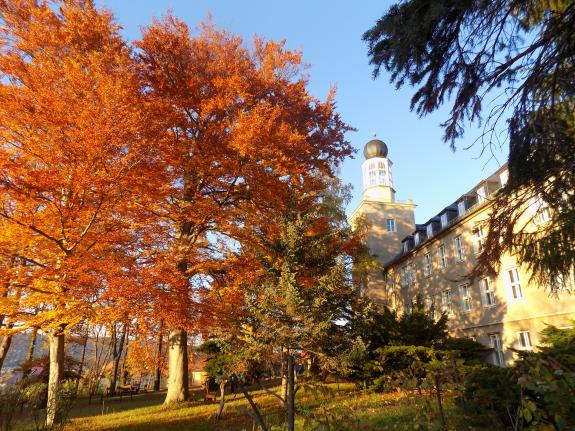
• Guided tour, including a climb up the tower, on the architectural history and use of the listed institute building.
• Why do mountain ranges form in the middle of a continent? A talk on the Institute’s geoscientific research in the Pamir and Tien Shan ranges of Central Asia.