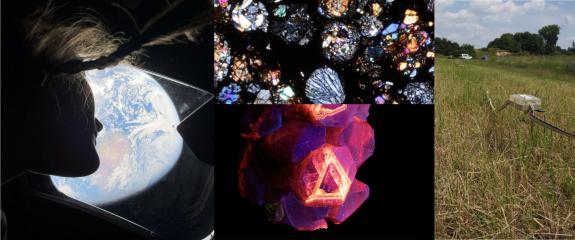
This is all about the world—and even beyond, to other planets and meteorites. You can:
· Experience the fascination of the solar system’s primordial matter as we examine meteorites under a microscope together. Meteorites originate from the solar system’s primordial bodies—the asteroids—and are the oldest rocks. They provide unique insights into the formation and early development of the solar system and Earth. They also reveal long-past processes, such as the condensation and agglomeration of the first solid matter in the so-called solar nebula. The oldest meteorites—the carbonaceous chondrites—contain not only silicates but also organic matter, which reached Earth through impacts and may have served as building blocks of life. These meteorites are also the focus of current space missions in which the University of Jena is participating.
· Take a look at the Mineralogical Collection: Discover fluorescence in mineralogy. In 1801, Johann W. Ritter discovered ultraviolet (UV) light in Jena. The term “fluorescence” was not introduced until about 50 years later by G. Stokes, although the natural fluorescence of fluorite in sunlight had been known for some time. We’ll demonstrate and explain fluorescence using various minerals. UV light has a wide range of applications in modern earth sciences—from gemstone appraisal to the prospecting of industrial minerals, it’s all covered. Let us surprise you—and if you have a piece of ruby jewelry, feel free to bring it along and we’ll take a look at it together…under UV light, of course!
· Learn how we use geophysics to explore the Earth’s interior —without digging at all: Using methods such as geoelectrics, magnetics, and gravimetry, we can peer into the subsurface without breaking ground. We do this by utilizing electrical currents, the Earth’s magnetic field, and its gravitational field. These provide information, for example, about the stratigraphic relationships of rock layers. But they can also be used to detect groundwater, geological structures such as faults, salt domes, ore deposits, and other hidden objects—like archaeological finds—or underground cavities. There’s a lot to discover right beneath our feet. We’ll show you how it’s done.
· Experience a “bouncy castle” with a twist: Instead of earthquakes, seismic measurements detect and visualize our guests’ jumps. We’ll explain how these measurements work and how we operate within the Thuringian Seismological Network to monitor seismic activity in Thuringia and the surrounding area.
· Understanding plants as the link between the underground and above-ground worlds: Plants and photosynthesis have played a fundamental role in making our planet largely habitable—the ozone layer, a pleasant climate, and air to breathe. They are a geological force. Plants fluoresce, and through small experiments, we make the vital process of photosynthesis visible. We’ll show how it relates to carbon sequestration and the greenhouse effect, and how water scarcity affects it.