Plants and Insects as Natural Product Chemists
While plants have long been considered the primary source of medicinal compounds, insects have also emerged as surprising masters of natural product chemistry. Just like plants, they synthesize complex molecules that could open up new avenues in drug development—from pain management to the treatment of infections and cancer.
In the Department of Natural Product Biosynthesis at the Max Planck Institute for Chemical Ecology, we investigate how various plants and insects produce such bioactive compounds. Our focus is not on the effects of the substances, but primarily on the question: How are these molecules formed?
Among our research subjects is the iboga plant from Africa, which produces the alkaloid ibogaine—a molecule with promising properties for the treatment of addictive behavior. The leaves of the Madagascar periwinkle produce the active compounds vinblastine and vincristine, which play a crucial role in cancer therapy. And the strychnine tree produces strychnine, one of the most complex natural molecules known.
But insects are also true chemical geniuses. Here are a few examples: mint leaf beetles store and synthesize cardiac glycosides, which can be used, for example, to treat chronic heart failure. Oil beetles produce a highly toxic substance, cantharidin, which is used for the topical treatment of warts.
The Department of Natural Product Biosynthesis at the Max Planck Institute for Chemical Ecology investigates the enzymatic building blocks of natural product chemistry. These molecules are often highly complex, and their synthesis requires a precise sequence of enzymatic steps—much like a perfectly synchronized orchestra.
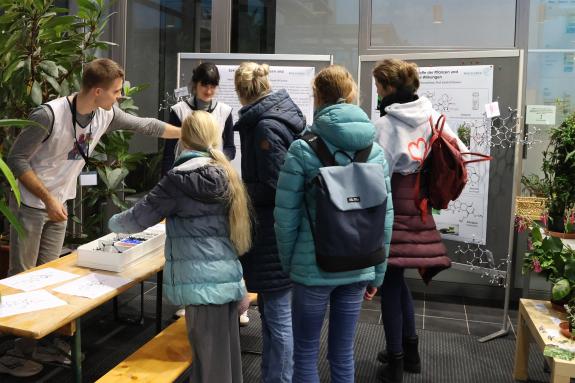
We invite you to learn more about these fascinating natural products. And you can experiment for yourself: Using a kind of “chemistry Lego” made up of building blocks and compounds, you can recreate the fascinating active compounds from plants and insects in a 3D model. Perhaps you’ll then discover what never ceases to amaze us: Plants and insects are amazing chemists.