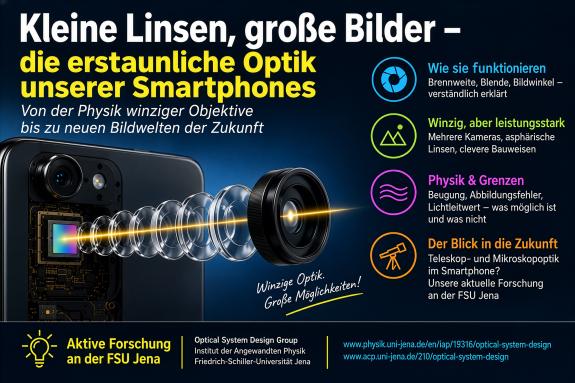
Small Lenses, Big Pictures—The Amazing Optics of Our Smartphones
Hardly any other optical system is as much a part of our everyday lives as the camera in a smartphone. But what seems like magic at first glance—crystal-clear images from a device just a few millimeters thick—is the result of sophisticated optics, clever physics, and innovative engineering.
This talk takes you on a journey into the world of modern smartphone cameras. You’ll learn what terms like focal length, aperture, and megapixels really mean—and why they alone don’t tell the whole story about image quality. Why do today’s smartphones need multiple cameras? Why are their lenses often unusually shaped? And what role do physical limitations like diffraction, aberrations, and the tiny sensor area play?
Using real camera modules—some of which have been cut open—we’ll see just how complex these miniaturized optical systems actually are. At the same time, the lecture will show where the limits of further miniaturization lie—and how innovative approaches from optical design, new technologies such as free-form surfaces or metalenses, and computational imaging are pushing these limits today.
A special focus is on current research questions being addressed by our group at the University of Jena: To what extent can the functionality of a smartphone camera be expanded beyond traditional photography? Can extremely compact systems with small fields of view provide sufficient light and resolution for telescope-like applications? And is it possible to develop high-performance close-range and microscopic optics that could be of interest for health monitoring, diagnostics, or other forward-looking applications?
A brief outlook also shows how alternative perspective projections could open up new possibilities for extreme wide-angle photography—and what role the smartphone camera will play in the optical research of tomorrow.