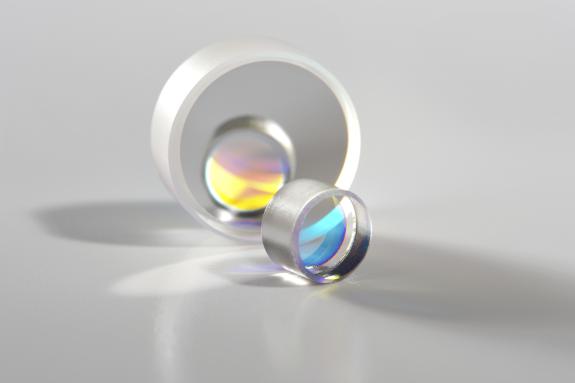
Thin Films for the World of Optics
Light is so ubiquitous and commonplace in our daily lives that we hardly ever think about its characteristics. Yet it’s worth taking a closer look.
We’re all very familiar with the fact that light consists of electromagnetic waves—a concept we learned in school. The spectral range visible to the human eye lies between 400 nm and 700 nm. That is, from the short-wavelength blue region to the long-wavelength region of the light spectrum, which we perceive as red light. But even outside the visible spectrum, electromagnetic light waves exist in a wide variety of wavelength ranges. Physically, these spectral ranges are roughly divided into the ultraviolet (UV) range, the visible light (VIS) range, and the infrared (IR) range.
What all these regions have in common is that light from all spectral regions can be used to transmit information; in other words, light from all spectra enables the acquisition of data and information.
Optics Balzers Jena GmbH, one of five global locations of Materion Precision Optics—a division of Materion Inc.—has made a name for itself in the development and production of optical filters. Optical filters are used to modulate light—in the spectral range from UV to well into the IR range—in a manner tailored to specific applications.
How are these filters made? Using thin-film coating, a wide variety of materials are deposited onto optically transparent substrates. This process is colloquially referred to as “vapor deposition.” In fact, in some processes, materials are thermally vaporized and deposited onto the corresponding substrates.
The thickness of the individual layers is sometimes only a few nanometers. By way of comparison, a human hair is approximately 100 µm thick—that is, 100 to 1,000 times thicker than the layers produced in this way.
The layer systems are designed such that the propagation of incident light is influenced by its interaction with the coating materials. Based on physical laws such as diffraction, absorption, and reflection, this interaction enables the targeted manipulation of the incident light. Only the portion of the spectrum required for the application is transmitted in the finished product. In this way, specific regions of the entire light spectrum that are of interest for the respective application can be “filtered out.”
But filtering spectral regions is not the only possible application. Light can also be influenced in entirely different ways based on the physical principles mentioned above. Light can be split into different polarization directions. While some waves propagate horizontally, others propagate only vertically. Each of these waveforms can carry different information. The separation and recombination of both waveforms is also made possible by optical filters. It quickly becomes clear just how complex the topic of optical filters can be and what a wide variety of applications can be realized using the coating technology of Optics Balzers Jena GmbH.
Optical filters are used to verify the security features on banknotes. Barcode scanners use optical filters to verify the barcode pattern in milliseconds. To prevent scanning errors, a special filter suppresses ambient light. This ensures that the sensor receives only the information essential for data acquisition. Measurement systems in biomedicine are equipped with fluorescence filters. These enable the detection of viruses and bacteria. This is an application that has developed very rapidly and extensively, particularly as a result of the COVID-19 pandemic. Everyone is now familiar with the term “PCR test.” This, too, is based on optical technology.
Mapping and observing the Earth from space would be unthinkable without optical filters. We are therefore proud that our filters—following qualification processes that in some cases took several years—are being used in various satellite missions. These enable the collection of data that is used for weather analysis as well as for assessing, for example, air quality or soil moisture.
Applications can be found in all areas of daily life—whether in solutions for autonomous driving, in optical metrology, or in medical diagnostics. Optical filters are—and will increasingly become—an essential component of modern automation and imaging.
Optics Balzers Jena GmbH can now look back on a company history spanning more than 25 years. What began as a spin-off from the Fraunhofer Institute for Optics and Precision Mechanics (IOF Jena) has since developed into a globally recognized company. Today, approximately 90 employees at the Jena location are responsible for the development and production of optical solutions. The unbroken demand for optical solutions is impressively reflected in the company’s growth.
We would like to present our solutions and capabilities to you during the “Long Night of Science” and cordially invite you to visit us at our facility.