Experiencing Democracy? Attitudes, Language, and Digital Technologies
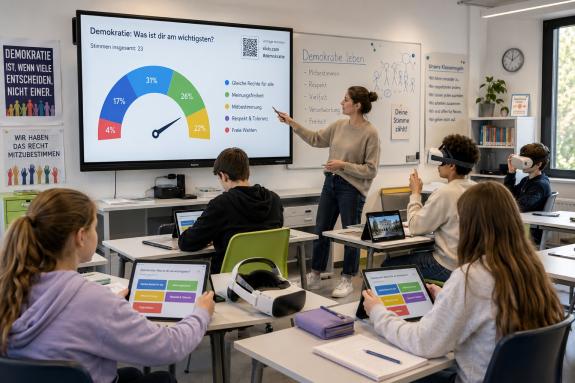
Democracy education is a crucial responsibility of schools and colleges. Questions that arise in this context include: How should we deal with discriminatory statements? What anti-democratic codes and symbols appear on social media? What are the political attitudes of young people and adults toward democracy? How can digital technologies such as AI and VR contribute to participation and a culture of interaction in schools and classrooms? We address these and other questions through a wide range of informational and hands-on activities.
To this end, we offer exciting insights into current topics at the “Learning To Teach Lab: Science” (LTL:S) at the Institute of Education, in cooperation with the Center for Research on Right-Wing Extremism, Democracy Education, and Social Integration (KomRex), we offer exciting insights into current research topics and practical applications of democracy education.
The following highlights are planned:
6:00 p.m. (30 minutes)
Perceptions of Democracy in Thuringia – Findings from the THÜRINGEN-MONITOR
Innovations in Teacher Education in Jena: Teaching and Learning in the Learning To Teach Lab: Science (LTL:S)
6:30 p.m. and 8:00 p.m. (30 minutes each)
Workshop: “How Do I Respond to Discriminatory Statements? The ForDiSens Project”
7:00 PM and 9:00 PM (15 minutes each)
Preliminary Findings from the Live Democracy Monitor: Political Attitudes of Youth and Adults
The following activities will be available to explore and try out throughout the evening:
• Live Democracy Monitor on the political attitudes of young people and adults: Your opinion counts!
• Emoji Quiz: Recognizing far-right codes and symbols on social media
• Learning to Argue: The AI Avatar “Marco”
• Virtual Reality: Practicing classroom management and teacher-student conversations in participatory lessons
• Video-based simulations: Practicing classroom discussions and parent-teacher conferences through role-playing
• FAKT-O-MAT: Use the FAKT-O-MAT—with 24 questions on two topics—to find out where fact ends and opinion begins.
• Poster exhibition on current research projects