French and Italian Manuscripts from Central Germany (16th–18th Centuries)
In the Early Modern Period, French and Italian were widely used throughout Europe as important languages of communication and culture, and were employed not only in diplomacy, trade, and scholarship, but also in private correspondence among European nobles.
The lecture will first examine the reasons for the special status of French and Italian in early modern Europe, before delving deeper into the use of both languages as languages of correspondence in the Central German region.
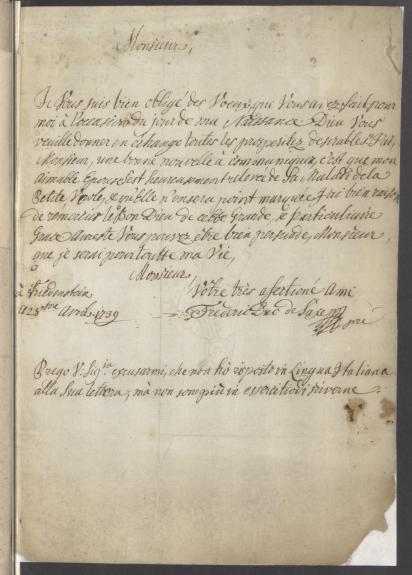
To gain an authentic insight into the spread of French and Italian in Central Germany, the French- and Italian-language correspondence of various Central German princes and princesses will first be examined in detail. The letters examined consist of previously unpublished source material that was discovered in Central German archives (Altenburg, Gotha, Jena, Weimar, Dresden, Dessau). Among the correspondents are figures such as Bernhard of Saxe-Jena (1638–1678), Sophia Albertine of Saxe-Hildburghausen (1683–1742), Frederick III of Saxe-Gotha-Altenburg (1699–1772), Ernst Friedrich II of Saxe-Hildburghausen (1707–1745), Karl Friedrich of Saxe-Meiningen (1712–1743), Johann Friedrich of Schwarzburg-Rudolstadt (1721–1767), and Ernestine Auguste Sophie of Saxe-Weimar-Eisenach (1740–1786). Based on the letters, the presentation will examine in particular why and on what topics the nobles corresponded in French or Italian. Furthermore, it will assess how well they actually mastered the two languages.
In the second part of the lecture, selected French and Italian textbooks for German speakers from the 16th and 18th centuries will be presented; these were produced in the Central German region and, in some cases, exist only as manuscripts.
Following the lecture, attendees will have the opportunity to view selected manuscripts (photographs) and attempt to read them—with assistance from the organizers if needed.