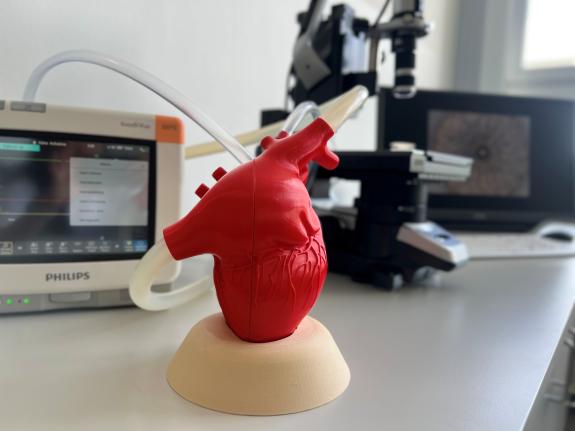
A hole in your heart? Get an up-close look at modern heart implants using a model!
What actually happens inside our hearts, and how can defects be repaired without opening the chest? At our booth, you can experience the fascinating world of modern medical technology up close: see it, understand it, and try it out for yourself!
The Heart in Action: Blood Flow & Implants Up Close
The centerpiece of our booth is a heart-and-vein model with fluid flowing through it. To simulate the human circulatory system, fluid is continuously pumped through the vascular system. A so-called LAA occluder—a specialized implant that closes off the left atrial appendage—is already in place in this model.
Why is this important? In people with atrial fibrillation, dangerous blood clots can form in this bulge of the heart, which in the worst case can trigger a stroke. The occluder precisely seals off this area. The running model provides a live, hands-on demonstration of how such an implant fits and functions under real-world flow and pressure conditions.
Hands-On Station: Step into the role of the clinician
But the heart has other vulnerabilities that can be treated using minimally invasive techniques:
• Patent foramen ovale (PFO): A valve-like connection between the atria that did not close completely after birth.
• Atrial septal defect (ASD): An actual “hole” in the wall separating the atria that can cause the heart to be permanently overloaded.
Both defects are now treated without major surgery: A folded implant is guided into the heart via a narrow catheter and unfolded there. Like a tiny double umbrella, it attaches to the septum from both sides and permanently seals the opening. Using a specially 3D-printed heart model, you can place a PFO or ASD occluder yourself! As you insert it, feel the resistance, the tactile feedback, and the moment when the little umbrella unfolds perfectly and anchors itself. This makes a highly complex medical procedure understandable for people of all ages.
The research behind it: The HeLab project (funded by the Carl Zeiss Foundation)
In the HeLab project at the Department of Medical Technology at Ernst Abbe University of Applied Sciences in Jena, we are developing innovative testing and evaluation environments (simulated-use models). Before a new cardiac implant can be used in humans, it must undergo years of testing to prove that it is completely leak-proof, safe, and mechanically robust. Our simulated heart-vein models form the basis for testing implants under realistic conditions—a crucial step on the path from the initial idea to an approved medical device.
Stop by, take a look inside the heart, and discuss materials, 3D printing, and the future of medical technology with our research team!
• Target audience: Suitable for anyone with a curious mind, regardless of age.
• Prior knowledge: Not required. Your enthusiasm for trying new things is all you need!
We celebrate science!