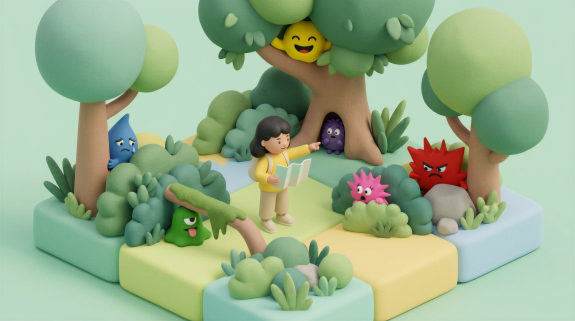
Focus on Emotions: The Long Night of Emotions
During our Long Night of Emotions, we bring psychological research to life: We show how emotions arise, how they shape our daily lives, and how we can better manage them.
Visitors are invited to get involved—through experiments, interactive stations, and discussions. In doing so, we bridge the gap between current research and very specific questions:
How do I cope with stress? What supports my mental health? And what can I do when I or others aren’t feeling well?
Our goal is to make knowledge understandable, tangible, and personally relevant—for children, teens, and adults.
Lectures/Workshops:
- “Climate, Crisis, Emotional Chaos? – Young People and Climate Change”: An interactive short presentation on the feelings children and teens experience in connection with climate change and how to effectively manage these feelings. Target audience: anyone interested
- “Is Everyone Mentally Ill?! What Is Mental Health, and How Are Young People in Germany Doing?” Target audience: parents, teachers, and others interested
Hands-on Activities:
- “Experience Anxiety Research in a Video Game Experiment – How Does Acute Danger Influence Our Predictions of Events?” Visitors are invited to participate in a video game-style experiment where they must keep a panther at a distance; we’ll explain how this game is used to explore human expectations; children can aim to achieve a high score; Target audience: children & teens
- “Can Your Heart Deceive You? Heartbeat & the Moment—Physiological Parameters in Science”: At two hands-on stations, we’ll show interested participants how we collect and use physiological parameters in psychological studies; we introduce heart rate measurement and eye-tracking methods through short experiments (Does my heart really beat as fast as I think it does? Where do I look first when meeting someone for the first time?); Target audience: children & teens
- “What to Do When There’s No Therapy Spot Available?”—I-WAIT: Development and evaluation of a transdiagnostic mobile intervention for children and adolescents; we’ll present our newly developed app designed to bridge the waiting period for a therapy spot, and we’ll offer interested participants an initial look at the modules and exercises we’ve developed—feedback on the design, usability, etc., is very much welcome; Target audience: Adolescents
- “Building on Strengths” —At a hands-on station, we’ll collect examples of strengths from children, adolescents, and families that help them cope with stress at school, in daily life, and elsewhere
Information booth about our University Psychotherapy Outpatient Clinic for Children, Adolescents, and Families (PHAK):
We’ll explain: How does therapy work here? How and when can you register with the PHAK? etc. Target audience: children, adolescents, parents, and interested members of the public
“Myths vs. Facts” – Myths surrounding mental illness: We address popular myths—such as those spread by influencers on social media—and, through discussion with the audience, clarify their truthfulness; participants are welcome to ask their own questions; Target audience: Adolescents